I'm delighted to share that our recent paper on Italy's marginal areas has received major press coverage from Corriere della Sera Torino, one of Italy's leading national newspapers. The story ran as the front-page lead in today's edition, with a full page (page 3) dedicated to the research, including a dedicated Q&A interview with me.
You can read it here:
What the article covers
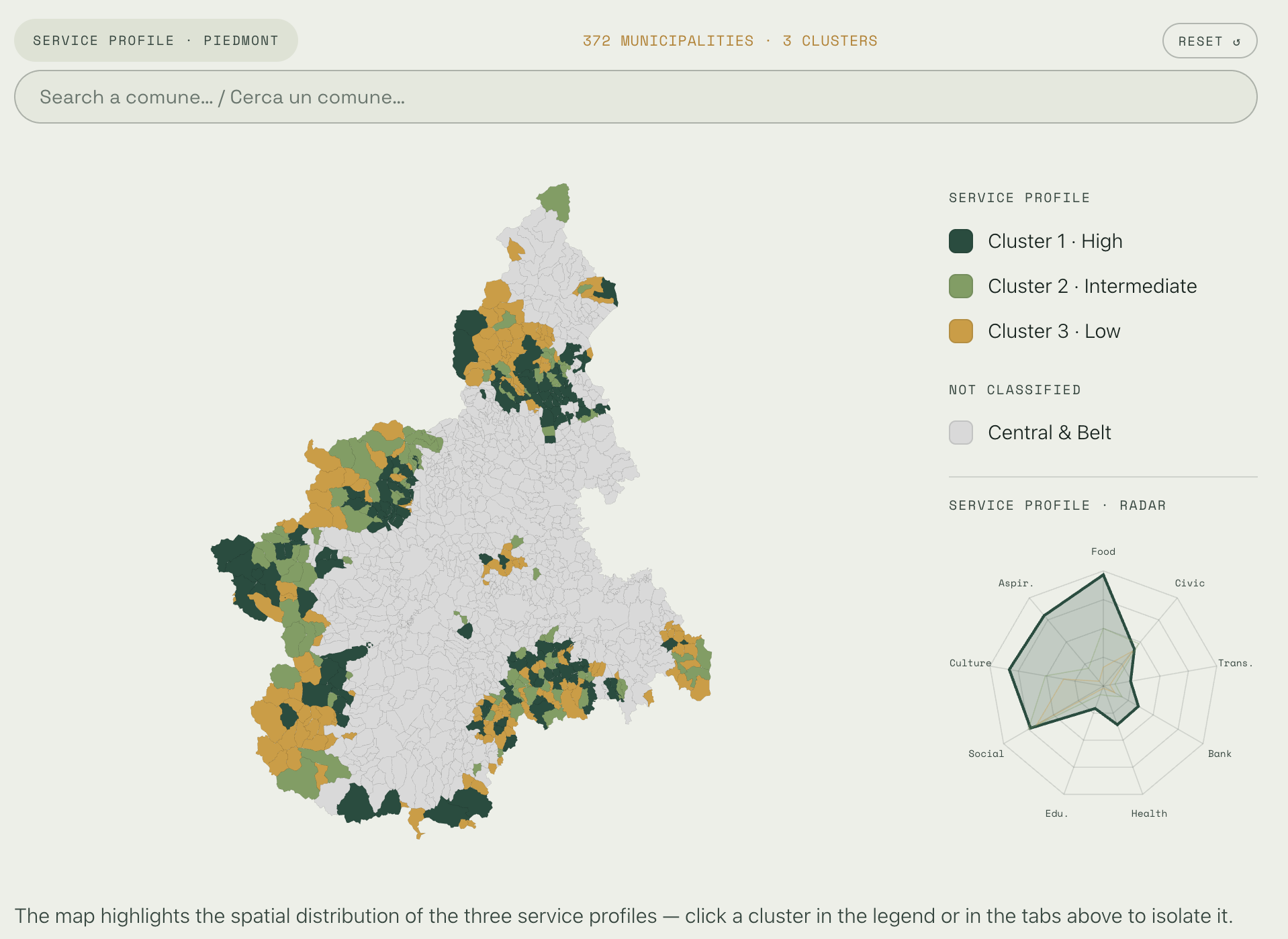
The piece, titled "Desertificazione in Piemonte, sono 372 i comuni sotto la lente" ("Desertification in Piedmont: 372 municipalities under the lens"), walks readers through the core findings of our study: an analysis of 372 marginal municipalities in the Piedmont region, built by combining official statistical data with over 17,000 service locations geolocated via Google Maps. The resulting Foundational Economy Index maps how well each municipality is served in terms of essential services — healthcare, food, education, transport, and more — and classifies areas into clusters ranging from well-served to critically underserved.
A central theme of the piece is the depopulation risk facing Italy's peripheral areas: municipalities classified as marginal are losing residents at roughly double the rate of more central towns. The article also highlights something we found particularly striking in the data — the emergence of "hub multiservizio" (multi-service hubs), small local businesses such as bars, tobacco shops, and general stores that have organically expanded to cover multiple essential functions (groceries, parcel collection, informal social gathering spaces) in villages where formal services have disappeared. The piece includes on-the-ground testimony from shop owners in small Piedmont municipalities describing how these hubs have become anchors of daily life, especially for elderly residents and younger people who might otherwise leave.
The interview
Alongside the main article, I was interviewed about the motivations and implications of the study. In it, I discuss why we chose to combine official statistics with crowd-sourced service data, what the research revealed about the gap between chronically under-invested peripheral areas and central hubs, and why we think tools like this can help local governments make more targeted decisions — where to place a new school, a supermarket, or a healthcare point — rather than relying on population or GDP figures alone. I also touch on the limits of tourism as a substitute for essential services, and on why monitoring these dynamics empirically is a necessary first step toward reversing depopulation trends.
It was particularly nice to see Northeastern University London cited directly in the piece, alongside my affiliation with ISI Foundation.
The research behind the story
This coverage is based on our paper:
Varavallo G., Barbera F. & Di Clemente R., Revitalizing Marginal Areas: A Foundational Economy Approach, Socio-Economic Planning Sciences 106, 102549 (2026). doi:10.1016/j.seps.2026.102549 — PDF
You can find more details on the project, including the interactive Foundational Economy Index tool, on the project page.
Thank you to my co-authors Giuseppe Varavallo and Filippo Barbera, and to everyone at UniTo and ISI Foundation who contributed to this work — and to Corriere della Sera for the thoughtful coverage.