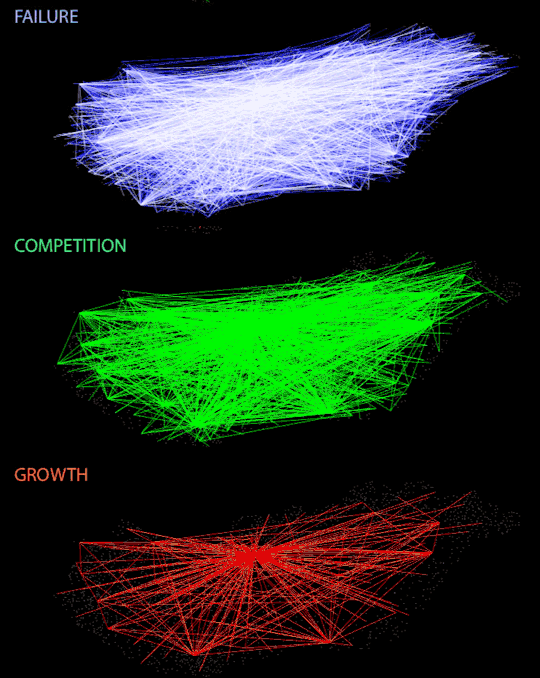
We illustrate patterns of spatial diffusion and churn with unprecedented detail by using data of the full life-cycle a social media website. We provide empirical evidence of non-trivial problems in spatial diffusion modelling, such as the role of local network structure, settlement size and geographical distance, which set the directions for correcting the models.
These results lead to a novel understanding on collective behaviour of adopting new online products and on the spatial aspects of how churn becomes collective at the end of their life-cycle.
Innovative ideas, products or services spread on social networks that, in the digital age, are maintained to large extent via
telecommunication tools such as emails or social media. One of the intriguing puzzles in social contagion under such conditions
is the role of physical space. It is not understood either how geography influences the disappearance of products at the end of
their life-cycle. In this paper, we utilize a unique dataset compiled from a Hungarian on-line social network (OSN) to uncover
novel features in the spatial adoption and churn of digital technologies. The studied OSN was established in 2002 and failed in
international competition about a decade later. We find that early adopter towns churn early; while individuals tend to follow
the churn of nearby friends and are less influenced by the churn of distant contacts. An agent-based Bass Diffusion Model
describes the process how the product gets adopted in the overall population. We show the limitations of the model regarding
the spatial aspects of diffusion and identify the directions of model corrections. Assortativity of adoption time, urban scaling
of adoption over the product life-cycle and a distance decay function of diffusion probability are the main factors that spatial
diffusion models need to account for.