New paper out in Frontiers in Complex Systems, with Anna Mancini, Antonio Desiderio, Giovanni Palermo, and Giulio Cimini!
In January 2021, a handful of Reddit users on r/WallStreetBets triggered a 30-fold surge in GameStop's stock price, inflicting massive losses on hedge funds that were betting against it. We wanted to understand the people behind that event: who were they, what made some of them so influential, and did the community change once the world started paying attention?
We built a semi-supervised framework to extract social roles directly from user behaviour on Reddit - rather than assuming a fixed set of roles in advance - and applied it to WallStreetBets from August 2020 to July 2021.
What we find:
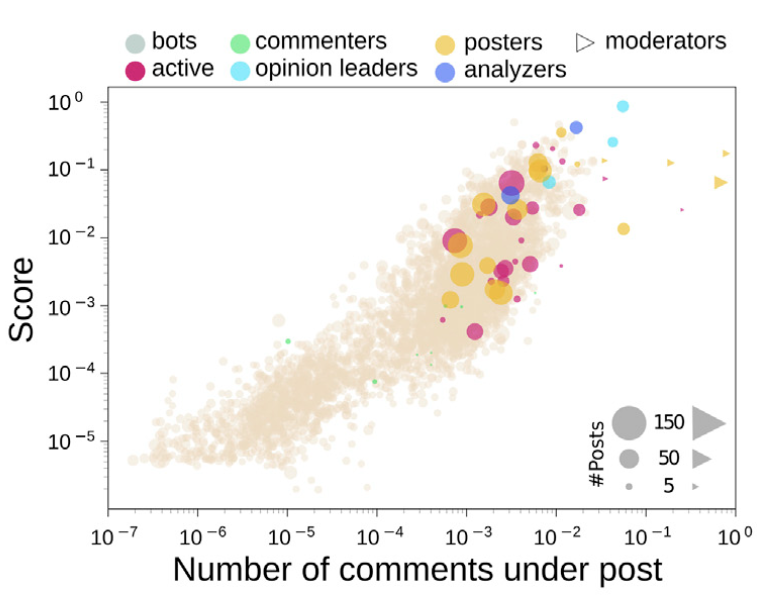
- Most users fall into three roles: commenters (mostly reply, rarely post), posters (write frequently, draw comments), and active users (high on both). During major events, commenters shift into more active roles, showing the community reorganising itself in real time.
- Among the small number of outlier users, we identify three candidate opinion leaders - each tied to a specific stock (GameStop, Corsair Gaming, and Palantir). All three share the same pattern: an extreme, high-risk investment, persistent updates on their progress, and - crucially - success. Only one of them, the "GME leader," managed to pull the entire community's attention onto his chosen stock, a key ingredient in the short squeeze actually happening.
- After the squeeze, WallStreetBets changed. No new opinion leaders emerged, due diligence posts gave way to memes, and conversations became shorter and less focused on investing - evidence that the very notoriety the community gained made it harder to repeat what it had just done.
Mancini, A., Desiderio, A., Palermo, G., Di Clemente, R., & Cimini, G. (2026). The rise and fall of WallStreetBets: social roles and opinion leaders across the GameStop saga. Frontiers in Complex Systems, 4:1924415. https://doi.org/10.3389/fcpxs.2026.1924415