 Remote work emptied out city centres. But someone still has to run the till, staff the ward, keep the café open — and I wanted to know who. With Zsófia Zádor and Balázs Lengyel, I'm sharing our new paper on workplace dependence: the physical presence cities can't shed, even when everyone who can leaves.
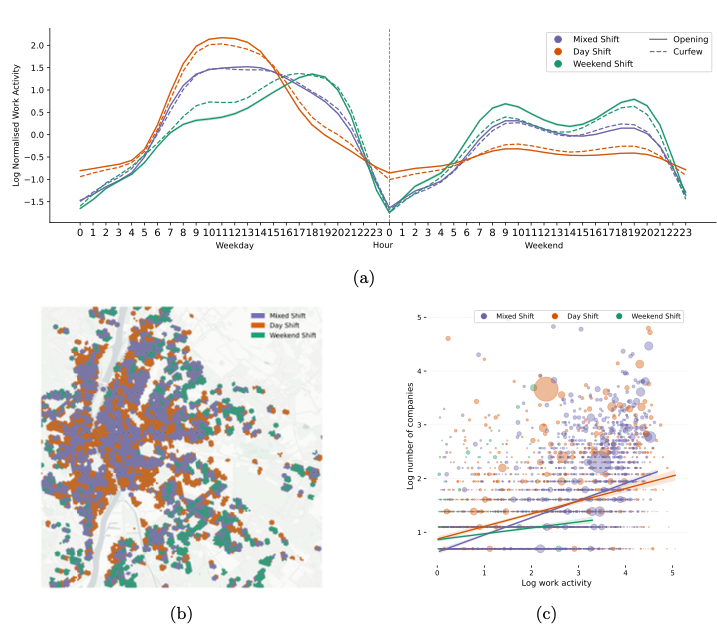
We tracked 1.4 million mobile devices across Budapest, paired with detailed company records, comparing a normal working month in autumn 2020 against a sudden COVID curfew a few weeks later. That sharp before/after gave us something rare: a real measurement of who kept showing up, not just who says they could work from home.
Three things stood out. Central office districts — the most productive, least diverse workplaces — emptied fastest. Industrial and peripheral areas barely budged; you can't run a warehouse from your kitchen table. And right in the centre, the people who stayed were disproportionately women, in income-mixed workplaces — not by preference, but because face-to-face service roles are concentrated among them. As remote-capable workers pulled out, the workforce left behind got more homogeneous, not more mixed — which is the opposite of what city centres are supposed to do.
We call this a service trap: being close to the centre compounds the disadvantage of not being able to work remotely, layering a geographic penalty on top of an inequality that already hits the same people hardest.
Zádor, Z., Lengyel, B., & Di Clemente, R. (2026). Workplace dependence in urban economies. arXiv:2608.07588 [econ.GN]. https://arxiv.org/abs/2608.07588
Great collaboration as always with Zsófia Zádor and Balázs Lengyel at ANETI Lab.