Epidemics of Liquidity Shortages in Interbank Markets

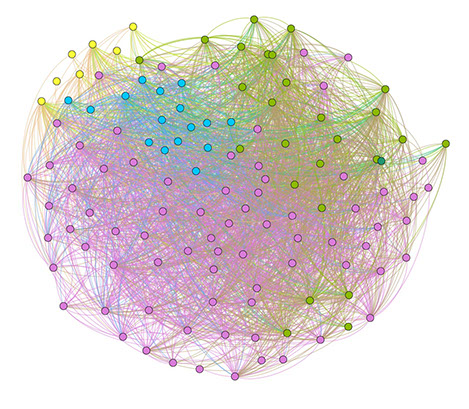
Interbank network structure

Financial contagion from liquidity shocks has recently been recognized as a prominent driver of systemic risk in interbank lending markets. When one bank experiences liquidity problems, it may be unable to fulfill obligations to other banks, potentially triggering a cascade of failures throughout the financial system. Understanding and modeling these contagion dynamics is crucial for financial stability and regulatory policy.

Building on standard compartment models used in epidemiology, we develop an EDB (Exposed-Distressed-Bankrupted) model for the dynamics of liquidity shock reverberation between banks. This epidemiological framing is natural: liquidity distress spreads through financial networks much like infectious diseases spread through social networks, with transmission occurring through direct exposures (interbank loans) and susceptibility varying by institution.

The EDB Model and Empirical Validation

We validate our EDB model using comprehensive data from the electronic market for interbank deposits (e-MID), which provides detailed transaction-level information on interbank lending relationships. This high-quality data enables us to reconstruct the actual network structure and test our model's predictions against observed market behavior during critical periods.

Our analysis reveals that the interbank network was highly susceptible to liquidity contagion at the beginning of the 2007-2008 global financial crisis. The network structure at that time—characterized by high interconnectedness and concentrated exposures—created ideal conditions for rapid propagation of liquidity shocks. Small initial disturbances could cascade through the system, amplifying into major disruptions.

The subsequent micro-prudential policies adopted by banks and liquidity hoarding behavior fundamentally altered the network structure and dynamics. Banks reduced their interbank exposures, diversified their lending relationships, and maintained larger liquidity buffers. These defensive strategies increased the network's resilience to systemic risk—successfully dampening the propagation of liquidity shocks.

However, these risk-reducing behaviors came with an important and somewhat paradoxical cost: they dried out liquidity from the market. By simultaneously reducing their willingness to lend and borrowing less, banks created a collective action problem. While individual banks became safer, the market as a whole became less liquid, potentially hindering economic activity and making it harder for healthy banks to obtain funding during temporary shortfalls.

"Too Interconnected to Fail"

A critical finding from our research is that the individual riskiness of a bank—both its vulnerability to shocks and its potential to propagate shocks to others—is better captured by its network centrality than by its size or market participation alone. This supports the increasingly debated concept of "too interconnected to fail," which extends beyond the traditional "too big to fail" doctrine.

Banks that occupy central positions in the interbank lending network—those with many connections or those that serve as bridges between different parts of the network—pose disproportionate systemic risk. These institutions can act as super-spreaders of liquidity shocks, much like highly connected individuals in epidemic networks. Their failure or distress can simultaneously affect many counterparties, triggering cascading failures.

This finding has important regulatory implications. Macroprudential regulation should account for network position when assessing systemic risk and setting capital requirements. A medium-sized bank in a highly central network position may pose greater systemic risk than a larger but more peripheral institution. Risk assessment frameworks that ignore network structure may systematically underestimate the vulnerability of highly interconnected financial systems.

Our EDB model provides a quantitative framework for assessing these network effects, enabling regulators to simulate how liquidity shocks might propagate through actual interbank networks and identify the most systemically important institutions based on their structural position rather than size alone.

Research Metrics

Altmetric Attention

Citations

References

Brandi, G., Di Clemente, R. & Cimini, G.

Epidemics of Liquidity Shortages in Interbank Markets

Physica A: Statistical Mechanics and its Applications, 507, 255-267 (2018)