Inequality Is Rising Where Social Network Segregation Interacts with Urban Topology

Social network segregation and urban structure

Wealth is unequally distributed in urban areas, often leading to the segregation of individuals into neighborhoods with disparate access to education, healthcare, and the labor market. While economic inequality and residential segregation have been extensively studied separately, the mechanisms linking them through social networks and urban structure remain poorly understood.

In this research, we provide empirical evidence based on big data from a widely-used online social network that the structure of large-scale social networks strongly correlates with income inequality in towns and cities. We demonstrate that inequalities tend to grow larger when initial income disparities coincide with fragmented social networks—a phenomenon that creates self-reinforcing cycles of disadvantage.

How Social Networks Amplify Inequalities

Social networks amplify inequalities through fundamental mechanisms of social tie formation such as homophily (the tendency to connect with similar others) and triadic closure (friends of friends becoming friends). These forces sharpen social segregation, which manifests as network fragmentation—the division of social networks into disconnected or weakly-connected communities.

When people's social connections are limited to others of similar economic status, information about opportunities, resources, and social capital flows primarily within socioeconomic groups rather than across them. This creates parallel social worlds where access to job opportunities, mentorship, and economic advancement becomes increasingly stratified. The fragmentation of social networks thus transforms initial economic differences into widening gaps that persist across generations.

The Critical Role of Urban Planning

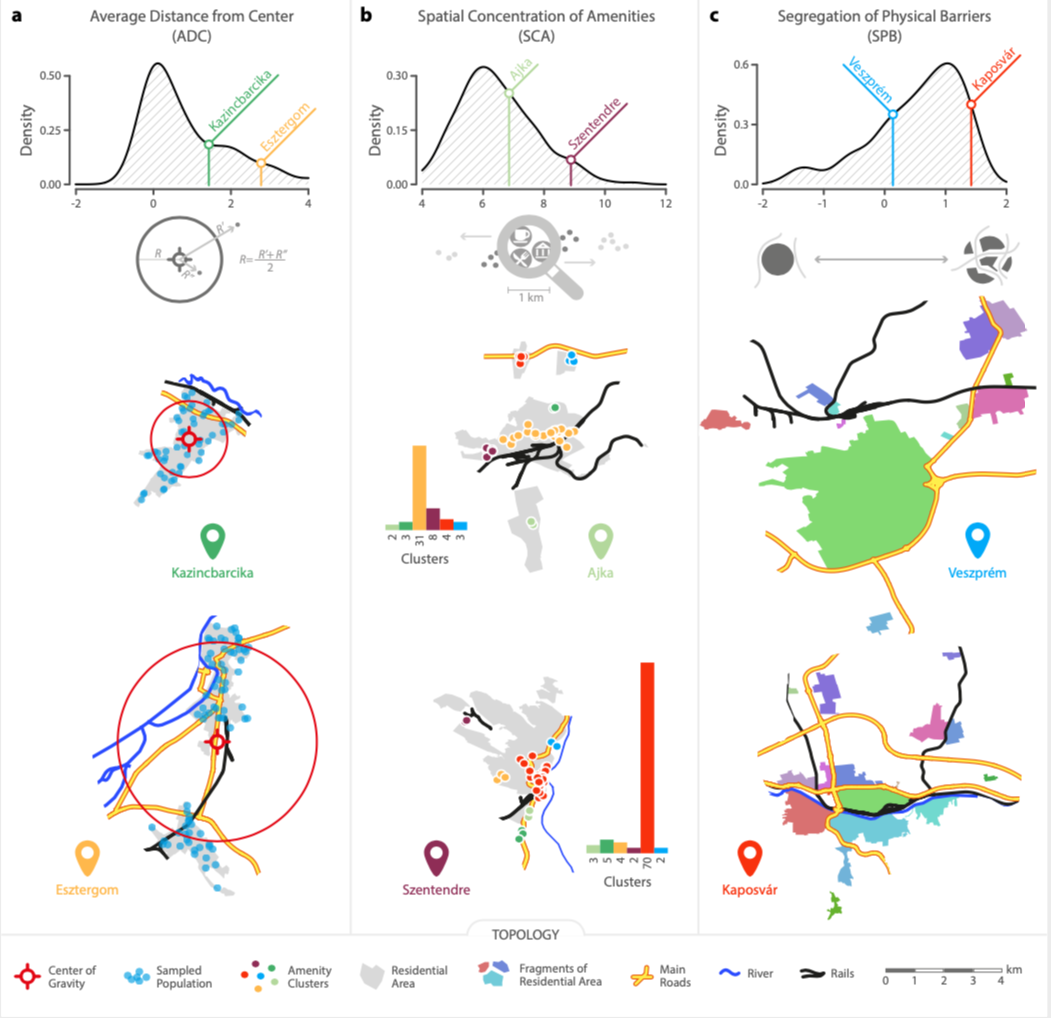
Seeking to better understand the relationship between social network fragmentation and inequality in towns, we find a remarkably strong correlation between divisive urban structure and social segregation. This relationship suggests that the vicious cycle of network effects on inequalities could be combated by designing better cities.

Our analysis reveals that the organization of physical urban space has a stronger relationship with social network fragmentation than unequal access to education, political segregation, or the presence of ethnic and religious minorities. Social network fragmentation is significantly higher in towns where residential neighborhoods are divided by physical barriers such as rivers, highways, and railroad tracks, and are relatively distant from the town center.

Towns in which amenities—such as parks, cultural venues, shopping districts, and public services—are spatially concentrated rather than distributed throughout the urban area also typically show more socially segregated networks. When daily necessities and social activities are unevenly distributed, residents from different neighborhoods have fewer opportunities for chance encounters and cross-group interactions that might bridge social divides.

These findings carry important implications for urban policy. They suggest that urban planning decisions—from the placement of transportation infrastructure to the distribution of public amenities—have long-term consequences for social cohesion and economic equality. By designing cities that facilitate rather than hinder social mixing across economic groups, urban planners may be able to interrupt the self-reinforcing cycles that amplify inequality.
Research Metrics

Altmetric Attention

Citations

References

Tóth, G., Wachs, J., Di Clemente, R., Jakobi, A., Kertész, J. & Lengyel, B.

Inequality is rising where social network segregation interacts with urban topology

Nature Communications, 12, 1143 (2021)