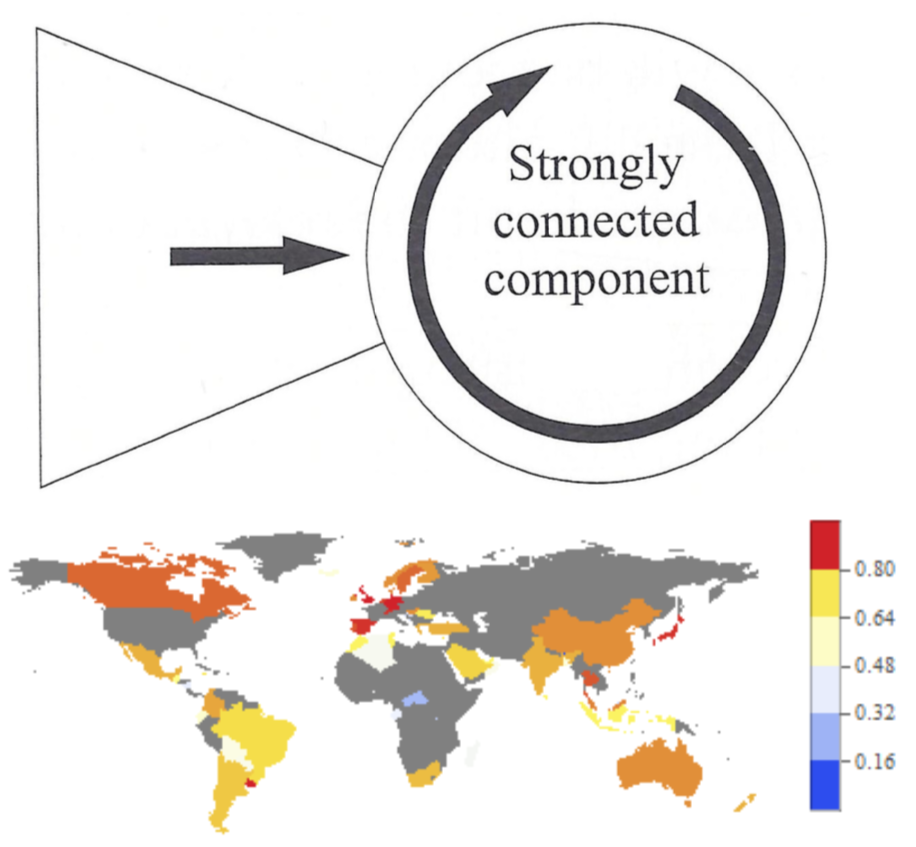
Our analysis reveals a surprising and important result: constraining the network degree sequence is often sufficient to reproduce bow-tie and core-periphery structures. This finding challenges the conventional wisdom that complex modular models are necessary to capture mesoscale organization. Using rigorous model selection criteria such as the Akaike Information Criterion (AIC) and Bayesian Information Criterion (BIC), we demonstrate that simpler degree-based null models frequently provide the most parsimonious explanation for observed mesoscale patterns.
This has profound implications for network analysis. If degree sequences alone can reproduce mesoscale structures, then many observed patterns may arise naturally from basic structural constraints rather than from specific organizational principles or functional requirements. This doesn't diminish the importance of mesoscale structures—rather, it suggests that they emerge robustly from fundamental network properties.
As a valuable byproduct, our research enriches the analytical toolbox for bipartite networks—a toolkit that remains far from complete. The bow-tie and core-periphery structures we study partition networks into asymmetric blocks characterized by binary, directed connections. This necessitated extending a recently-proposed method for randomizing undirected bipartite networks to handle the directed case, thereby providing researchers with new tools for analyzing directed bipartite systems.
We apply our methodology to two important real-world systems: the World Trade Web, where countries and products form a natural bipartite structure, and interbank lending networks, where financial institutions occupy different structural positions. In both cases, our approach successfully identifies whether observed mesoscale structures reflect genuine organizational principles or simply emerge from degree constraints.