Mapping three decades of international collaboration and citation in artificial intelligence
Over the last three decades, global research in artificial intelligence has been reshaped by the rise of new scientific powers. While the European Union and the United States dominated in the 1990s, China has caught up in international collaborations and citations, and now challenges their leadership. But raw volume only tells part of the story — who each country works with, and who cites whom, reveals a much more intricate geography of knowledge.
International AI collaborations (top) and external citations (bottom) for the US, EU-28, and China from 1990 to 2021. Hover a country to highlight its trajectory.
In 2021, Tunisia and France co-authored 52 articles. Italy and France co-authored 198. On the surface, Italy's link to France looks four times stronger. But Tunisia only collaborated on 352 articles in total, so France was 15% of its international collaborations — while for Italy, France was just 5% of its 3,630 co-authorships.
To capture what really matters, we compare each observed link to a null model: a randomized version of the network that preserves each country's total volume. The significance of a connection is how much larger (or smaller) it is than what randomness alone would predict.
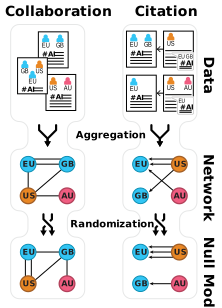
Fig. 1B from the paper. The null model preserves each country's total volume but randomizes who-pairs-with-whom. Links that are significantly thicker than expected by chance reveal the real geography of knowledge.
When we keep only the significant links — collaborations stronger than any null model would predict — two very different worlds appear between 2017 and 2021. Click the US hub and China hub buttons below to see each superpower's sphere of influence. Then try Bridges — the handful of countries that maintain significant ties to both poles.
Network of significant international AI collaborations (2017–2021). Node size = number of AI papers; edge = z-score > 2 after null-model randomization. Hover any country to see its partners; click to lock; hover a continent in the legend to isolate it.
From 2000 to 2021, the direct relationship between China and the United States has drifted into ever-weaker significance — they now collaborate and cite each other less than would be expected by chance, and the gap has been widening year after year. Two scientific superpowers, diverging in plain sight.
The China–US link in a two-dimensional significance space: collaboration (x) vs. knowledge exchange (y). Drag the year slider or press play to watch the drift. Lighter trail = earlier years.
Looking at every pair of countries in the AI research system, we find that bilateral relationships follow four characteristic patterns over 2000–2021. Each tells a different story about how scientific collaboration and knowledge exchange co-evolve.
Pairs getting closer scientifically AND exchanging more knowledge.
Pairs drifting apart in both collaboration AND citations.
Pairs citing each other more but collaborating less.
Pairs collaborating more but citing less.
Each line is a cluster centroid — the average trajectory of all country-pairs in that archetype. Press play or drag the slider to watch them grow synchronously. Hover or click a cluster button to isolate it.
Every major AI country is choosing — or being pushed into — one of a handful of positions. Some converge with the US, some with China, and a few with both. The United Kingdom and Germany have moved firmly into the US orbit. India, Poland, Singapore, South Korea, and Taiwan are the strongest evidence of active integration with China. France, Italy, the Netherlands, Canada, Japan, and Israel are bridges — maintaining strategic ties to both poles.
The 30 most productive AI-producing countries, positioned by their convergence direction and speed with China and the US over 2000–2021. Angle = orientation toward the poles; distance from center = speed of convergence.
Summary
The global AI research system is polarizing into two spheres of influence, with the United States and China at the centers. This divide threatens any prospect of globally coordinated AI governance. Yet a group of doubly integrated countries — many of them European, plus Japan, Canada, and Israel — still bridges both poles. Whether this bridging capacity is leveraged or eroded may determine the future integration of international AI research, and with it the viability of ethical, broadly beneficial AI.
Our findings inform national science policies and ongoing international AI regulation efforts, from the EU AI Act to the World Artificial Intelligence Cooperation Organization (WAICO).
Publication
- Gallo, L., Di Clemente, R. & Lengyel, B. Polarization and Integration in Global AI Research arXiv:2604.17602 (2026), under review. doi:10.48550/arXiv.2604.17602 PDF
Code & Resources
Partners