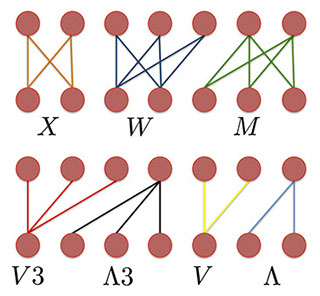
Null models for bipartite networks proposed so far suffer from several important limitations. Some are purely numerical, lacking analytical character and making them computationally expensive and difficult to interpret. Others assume an a priori functional form either for the distribution of quantities of interest or for the model's parameters, meaning they are not truly data-rooted. Still others rely on approximate analytical models that may fail to capture important features of real systems.
In this research, we propose a theoretical framework that overcomes these limitations by guaranteeing three crucial properties: it is analytical (providing closed-form expressions), data-driven (deriving all parameters directly from observed data without assuming functional forms), and exact (not relying on approximations). Our approach extends a recently-proposed method for randomizing monopartite networks to the bipartite case.
The method rests upon the sequential maximization of Shannon entropy and the likelihood function—a combination that has been proven highly effective both for detecting patterns and reconstructing the structure of several real-world networks. This information-theoretic foundation ensures that the null model makes minimal assumptions beyond those strictly required by the observed data.
While the proposed formalism is perfectly general and applicable to any bipartite network, we demonstrate its power through application to the binary, undirected, bipartite representation of the World Trade Web (WTW). Using data spanning from 1963 to 2000, we show how the method can reveal meaningful structural patterns in global trade that would be obscured without proper null model comparison.
The Bipartite Configuration Model (BiCM) we develop provides a principled way to test hypotheses about bipartite network structure. For example, it can determine whether certain products are disproportionately traded by certain countries, whether collaborative relationships between authors and papers show non-random patterns, or whether ecological networks exhibit nestedness beyond what would be expected by chance. This makes it an invaluable tool for researchers across diverse fields dealing with bipartite data structures.