The Italian Primary School-Size Distribution and the City-Size: A Complex Nexus

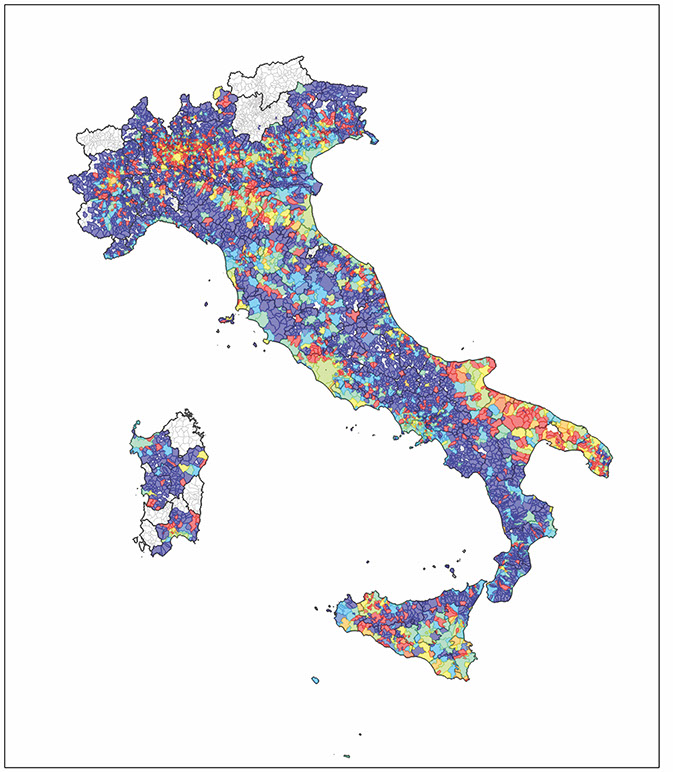
Map of Italian primary schools distribution

This project investigates the statistical distribution of the sizes of Italian primary schools. It is an interdisciplinary work in which the concepts and methods of complex systems are applied to investigate the Italian school distribution according to geographical features and population density.

Many scholars have shown surprisingly complex features governing cities, firms, or social groups, uncovering power law distributions, fat tails, and other properties incomprehensible in the scope of orthodox approaches. This framework proposes new challenges in studying socio-economic systems that have been discussed in various articles in the most important journals, such as Nature, Science, and American Economic Review.

Bimodal Distribution and Spatial Interactions

We introduce a definition of school size as the number of students currently enrolled in each school and we show that the probability distribution function (PDF) can be well approximated by a lognormal distribution. The school system shares certain elements with firms and cities, such as an abundance of small schools in the left tail of the size distribution, which exponentially decays. However, it also has specific and important features: the body of the PDF distribution manifests a bimodality characteristic. The evidence of the bimodality underlies the interplay between different processes that define thresholds and boundaries that are very peculiar for the Italian primary school-size distribution.

Motivated by the absence of any territorial constraint in school choice, and although the fat left tail of the school-size distribution has been particularly targeted in the past years by political interest and legislative attempts, there is no evidence of a rise in the size of schools in the lower quantiles. To disentangle the source of bimodality, we introduce a measure of the average spatial interaction intensity between a school and the surrounding ones in different Italian regions. We find that interactions are very weak, on average, for small schools, especially in countryside-based regions. This pattern involves small villages with only one school, whose closeness coincides with the proximity of other schools.

Policy Implications

Our conclusions indicate that the bimodality of the Italian primary school-size distribution is very likely due to a mixture predominantly driven by population density and, in turn, by the geographical features of the territory. This empirical work is directly aimed at addressing policy schooling decisions, providing the first formal complex systems approach to develop a better education system. Our analysis can be easily generalized to other countries and many other complex systems such as hospitals and other facilities that are strongly related to city size.

Research Metrics

Altmetric Attention

Citations

References

Belmonte, A., Di Clemente, R. & Buldyrev, S. V.

The Italian primary school-size distribution and the city-size: a complex nexus

Scientific Reports, 4, 5301 (2014)